MEDICAL SCHOOL
Duke University School of Medicine
If you are considering breast augmentation, you are probably deciding between implants and fat grafting, or both, and wondering how size is actually chosen. In my Ann Arbor practice, I plan around your frame, existing tissue, and goals. I utilize 3D simulation technology to help you visualize your desired outcome and to discuss realistic expectations. This page is a starting point.
Breast augmentation adds or restores volume with an implant or with fat grafting, where your own fat is moved by liposuction and injected back into the breasts. Neither approach reliably lifts a breast that has dropped significantly. If a lift is part of your picture, we discuss a breast lift alongside or instead.
With implants, the meaningful choices are silicone or saline fill, placement above or below the chest muscle, and incision. We weigh those tradeoffs together at consultation, based on your anatomy rather than a standard package.
Fat grafting suits a modest, soft increase, since up to half of the transferred fat is reabsorbed. Larger goals may need staged sessions or an implant instead.
Preserve: a minimally invasive option
For first-time breast augmentation, I also offer Preserve, a tissue-preserving technique developed by Motiva. Instead of creating the implant pocket by cutting, Preserve works through a small incision in the crease beneath the breast (the inframammary fold), where specialized instruments gently move your tissue aside to create a precise space for the implant. The technique is designed to preserve your natural breast tissue, your chest muscles, and nipple sensation.
Preserve uses Motiva SmoothSilk Ergonomix implants, which are designed for insertion through a smaller incision and adapt their shape as your body moves. I am currently the only plastic surgeon in Ann Arbor offering Preserve. It is not the right fit for every augmentation, so at your consultation we will decide together whether Preserve or a classic approach better fits your anatomy and goals.
At your consultation I look at the whole picture, not only the approach you have in mind:
Goals & Anatomy: A cup request helps me understand the look you want, but bra sizing is not standardized. I measure your breast dimensions, skin, and tissue, then translate your goal into a proportion that fits your frame.
Health & History: An autoimmune condition such as Hashimoto's does not automatically rule you out. For diabetes or another condition, we would partner with your primary care providers if needed to optimize your health and ensure your safety before surgery.
Timing: I want everyone to live their best lives, so I work around your plans and trips to find the right surgery date.
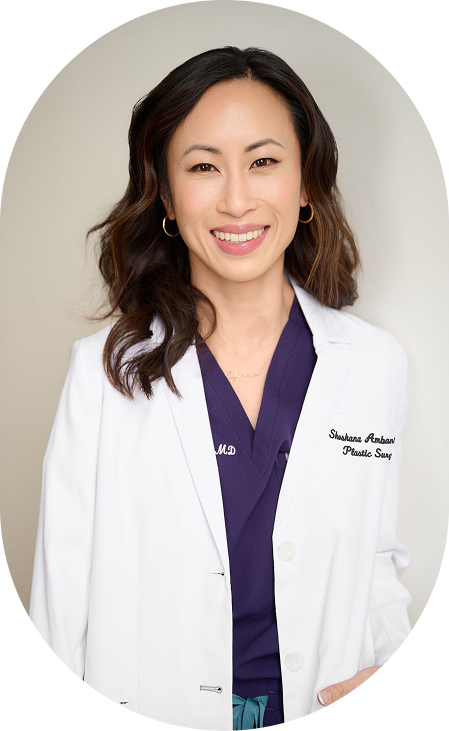
Board-certified Plastic Surgeon, Castle Connolly Top Doctor
Duke University School of Medicine
Plastic Surgery, University of Michigan Affiliated Hospitals
Microsurgical Reconstruction, University of Pittsburgh Affiliated Hospitals
American Board of Plastic Surgery
Castle Connolly Top Doctor in Plastic Surgery
A consultation is the clearest next step, and Dr. Ambani offers both in-person and virtual visits. Together you will settle the implant-or-fat-grafting question, your proportion goals, and whether a lift belongs in the plan.
You leave with a plan that fits your anatomy and priorities, or a clear reason to wait. When you are ready, reach out and we will help you plan your consultation with Shoshana Ambani Plastic Surgery.
Dr. Ambani uses Crisalix 3D imaging to simulate how different implant sizes and shapes may look on your own frame, so the size conversation happens against a picture rather than a number. You can view her Crisalix profile before your visit, and sign up in advance if you would like your simulation ready when you arrive.
Most patients feel the worst of the soreness in the first several days and return to desk work in about a week. Strenuous exercise usually resumes gradually around 4 to 6 weeks, and heavy upper-body lifting waits about 6 weeks or longer, once I clear you.
Fat grafting adds a liposuction donor site, so expect some extra soreness, bruising, and possibly minor unevenness there. It also carries risks of its own, including infection, fat necrosis, oil cysts or calcifications, loss of some transferred fat, and sometimes a touch-up session. Where your implant sits and how physical your job is can also shift the timeline.
Recovery usually involves a support garment, activity limits, and follow-up visits so we can watch your healing. Expect a supportive bra for a minimum of 8 weeks to optimize your long-term implant position and shape. Plan for help at home in the first days, and time off work suited to your job.
Shoshana Ambani Plastic Surgery is a cosmetic, self-pay practice, and we do not bill insurance for augmentation, monitoring, or any future revision. Cost depends on your path: implant supplies or liposuction extent, anesthesia, facility, and time in surgery. We review an itemized estimate once your plan is set, and can walk through financing your care.
If you are considering breast augmentation, you are probably deciding between implants and fat grafting, or both, and wondering how size is actually chosen. In my Ann Arbor practice, I plan around your frame, existing tissue, and goals. I utilize 3D simulation technology to help you visualize your desired outcome and to discuss realistic expectations. This page is a starting point.
It varies with your plan: implants or fat grafting, anesthesia, facility, and operating time. We share an itemized estimate afterward.
Saline often needs a smaller incision, and rupture shows as deflation. Silicone feels softer under thin tissue but can rupture silently, so the FDA recommends an ultrasound or MRI at five to six years, then every two to three years. It checks the implant, not for cancer.
Fat grafting gives a modest, soft increase using your own tissue, and some transferred fat is reabsorbed. Implants deliver larger, more predictable volume, so your goals and available donor fat decide it.
Often well over a decade, but implants are not lifetime devices and revision may be needed.
Implants carry surgical risks like bleeding, infection, and scarring. They can also bring sensation changes, asymmetry or movement, rippling, rupture or deflation, hardening of the normal capsule that forms around the implant (capsular contracture), and a rare implant-related illness called BIA-ALCL. We review the full list and FDA screening at consultation.
Most women can breastfeed after augmentation, and lasting sensation change is uncommon, though neither is promised. Incision placement plays a role, so we weigh it together.
Consultation-based, self-pay plastic surgery in Ann Arbor.
We offer virtual consultations for out-of-town patients, followed by an in-person exam to confirm your final plan.
